
We spent three nights at Apartma Ritual, with our main aim being to explore Slovenia’s wine-growing Vipava Valley. However, between excursions, we found time to discover the town we were staying in, Ajdovščina. Despite being told numerous times how to pronounce its name, we failed spectacularly to get it right!
For me, the town had three particular highlights.
The Roman Fortress
Ajdovščina is located on the site of the Roman settlement developed around Castra, a military fortress. Its impressive stone walls, originally strengthened by 14 towers, was remarkably well preserved, making it one of the most significant surviving examples of Roman military fortifications in Slovenia. A leaflet from the Tourist Information Centre helped us locate and explore the surviving sections of the walls and towers, although reminders of the Roman presence were all around us.
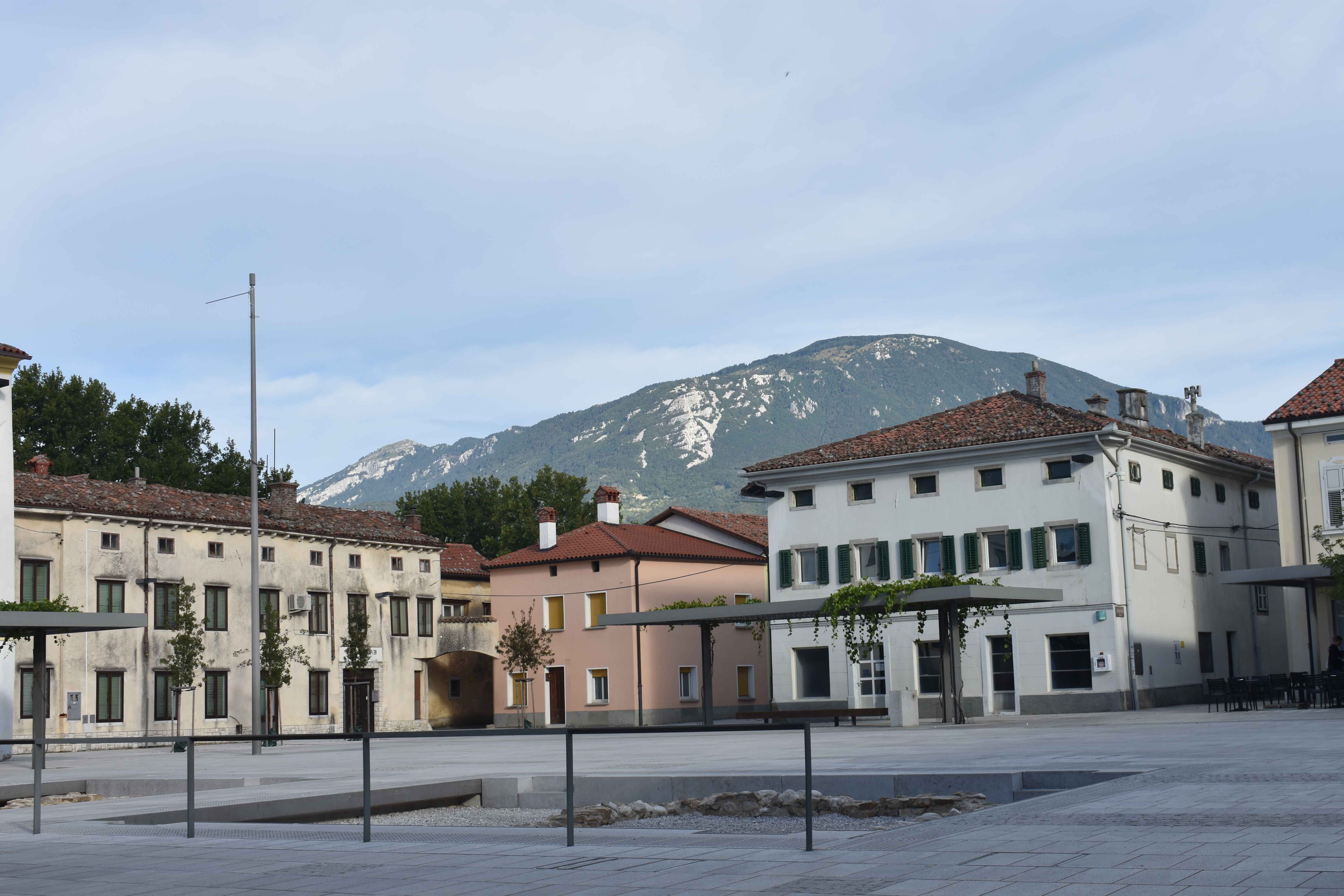
This heritage was particularly evident in the recently renovated Lavričev Trg (Lavrič Square), which became our base for eating and drinking. The paving, with stone slabs of varying sizes and arrangements, reflected the grid pattern of Roman urban design, whilst there were also several uncovered sections of Roman remains.
We enjoyed breakfast at Rustjeva Hiša Kruha (Rust’s House of Bread), which occupied a historic building constructed over substantial Roman remains. During restoration, archaeologists uncovered a well-preserved hypocaust, or Roman underfloor heating system, which we could see beneath a section of glass flooring, making an otherwise ordinary breakfast venue, part of history.
There were several information boards near the walls and one story we enjoyed was ‘The Battle of the Flying Arrows’. The legendary Battle of the Frigidus took place in Ajdovščina in 394AD, where a ferocious local mountain wind, the Burja, famously blew the arrows of the Western Roman army right back at them, altering the course of world history by solidifying Christianity across the empire.
Unfortunately, we didn’t have time to visit the archaeological collection at the Ajdovščina Museum, due to its limited opening hours.
The Pilon Gallery
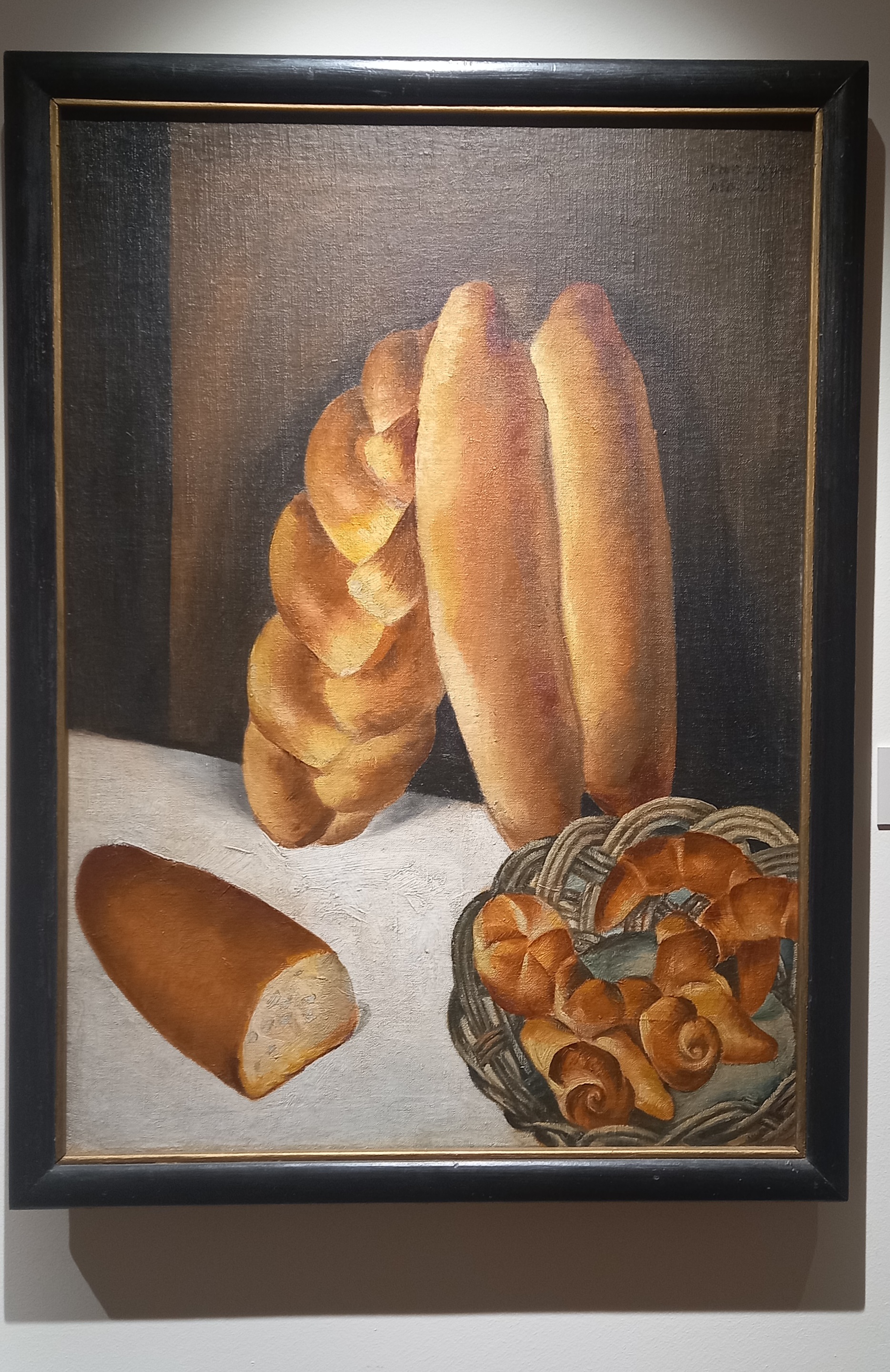
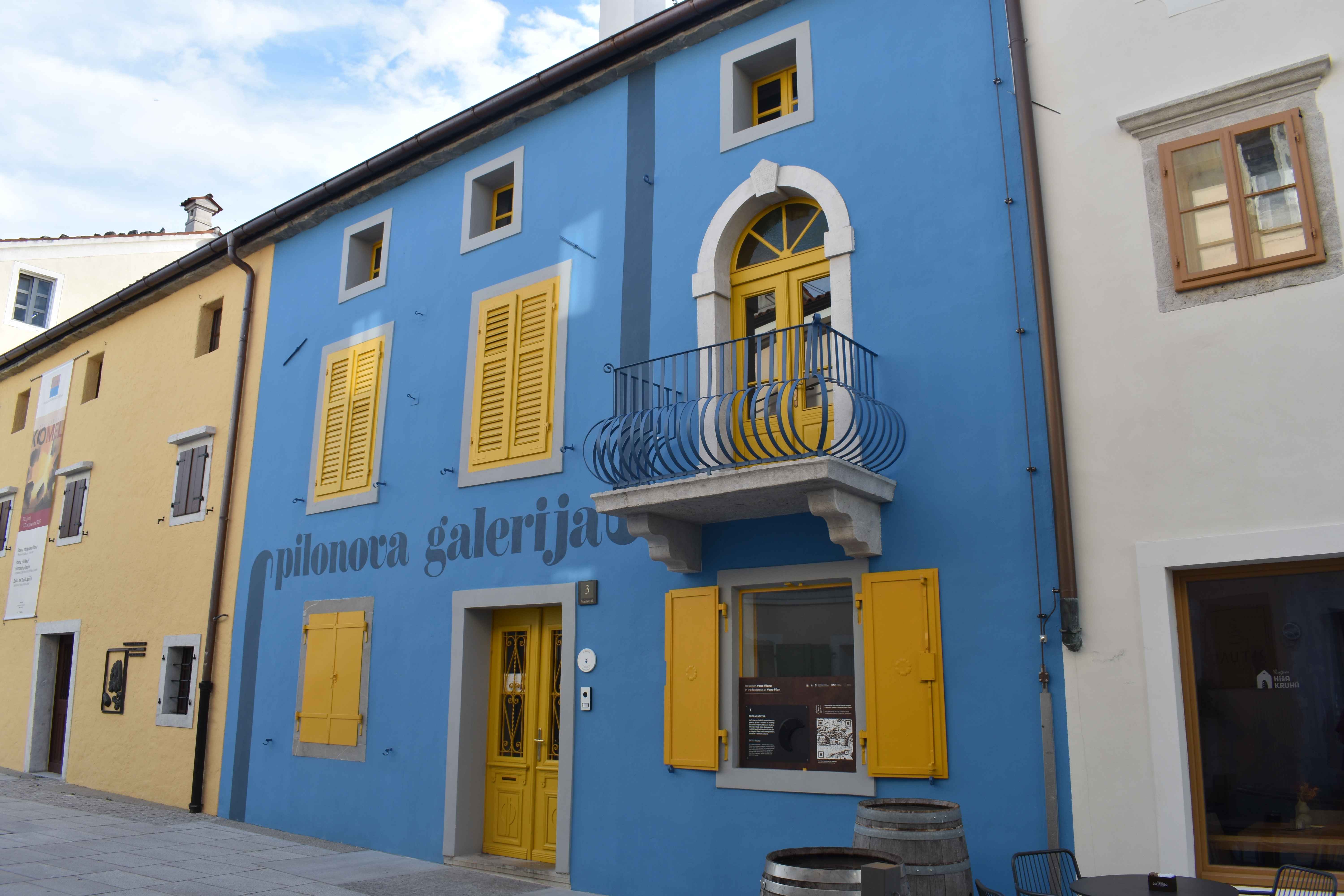
Veno Pilon was one of Slovenia’s most important artists, and we found the Pilon Gallery, directly opposite our apartment. Occupying two adjoining bourgeois townhouses, painted in a vibrant blue and yellow, one was the Pilon family home where his father ran a bakery. A bread-themed relief of his oil painting Kruh (Bread, 1922) on the exterior wall provided a nod to the building’s former life.
The gallery, spread over three floors, was beautifully presented and lit, with an extensive collection of Pilon’s paintings, drawings, prints and other works. There were also some rather entertaining interactive displays, hosted by a cartoon mascot called Mišek Venč (Venč the Mouse). There were three activities to choose from: ‘Pilon in the World’, an interactive digital map showing the places Pilon travelled and his international connections; ‘Jigsaws of Paintings’ where you selected an artwork and attempted to piece it back together digitally; and ‘Spot the Difference’ where you were challenged to identify the changes between an original painting and a digitally altered version. They were probably designed with children in mind, but as I was the only visitor at the time, I had them all to myself and found them fascinating! There were also virtual reality headsets, although I wasn’t entirely sure what I was supposed to do with them.
Alongside Pilon’s work, a temporary exhibition featured the paintings of Silvester Komel, an important Slovenian artist of the second half of the twentieth century.
The gallery was excellent value at the €5 admission price we paid.
The First Slovenian Government
Another important landmark was the Square of the First Slovenian Government, commemorating the establishment of the National Government of Slovenia in Ajdovščina on 5 May 1945, shortly before the end of the Second World War in Europe.
The building where the government was proclaimed is now used as a cultural venue and theatre. Nearby, we spotted a bronze bust of Ivan Cankar, one of Slovenia’s most celebrated writers, created by Veno Pilon. It was a fitting connection between two of the town’s most important cultural figures: the writer who helped shape Slovenian literature, and the local artist who immortalised him in bronze.
A Generous Benefactor and a Greener Town
As we drove out of Ajdovščina on our various excursions, we couldn’t help noticing the considerable number of what appeared to be newly planted roadside trees, and we heard about the town’s remarkable benefactor. Ivo Boscarol was a Slovenian aviation pioneer who founded Pipistrel, the internationally renowned manufacturer of light aircraft, in Ajdovščina. In March 2022, following the sale of a majority stake to an American company, he donated €25 million to the municipality. The money was earmarked for a range of projects, including improved healthcare facilities, helicopter rescue services, an aviation museum and environmental improvements with €1 million specifically allocated ‘urban greening’.
A Town with a Sweet Tooth
Although we didn’t get around to fully exploring Ajdovščina’s culinary credentials, the town has an interesting reputation for food manufacturing, particularly pasta and ice cream, as well as chocolate.
It is home to Mlinotest, one of Slovenia’s leading pasta producers, whose history dates back to 1867. The town celebrates its pasta-making heritage, with an annual Pašta Fešta (Pasta Fest), when the square becomes an open-air celebration of pasta and local gastronomy.
Ajdovščina is also known as Slovenia’s ‘city of ice cream’, thanks to Incom Leone. The business, established in 1989 and operating from a garage, is now Slovenia’s largest ice cream manufacturer. exporting its products internationally.
Its expansion into chocolate production began in 2020, with a dedicated factory focusing on innovative products and coatings for frozen treats. In addition, the region’s artisanal gourmet culture has popularized creative crossovers, such as local producers offering handmade chocolate-infused pasta.
We may not have sampled the local pasta or visited the ice cream factory, but it’s certainly a good reason to return!
Ajdovščina turned out to be much more than simply a convenient base for exploring the Vipava Valley. With its Roman remains, fascinating art gallery, important place in Slovenian history and thriving food industry, it was a town well worth exploring.
See also:
Exploring the Vipava Valley – Part 1 – Vipava Valley Wine Train
Exploring the Vipava Valley – Part 2 – Hike and Wine Experience
Exploring the Vipava Valley – Part 3 – Food Tour
Apartma Ritual