
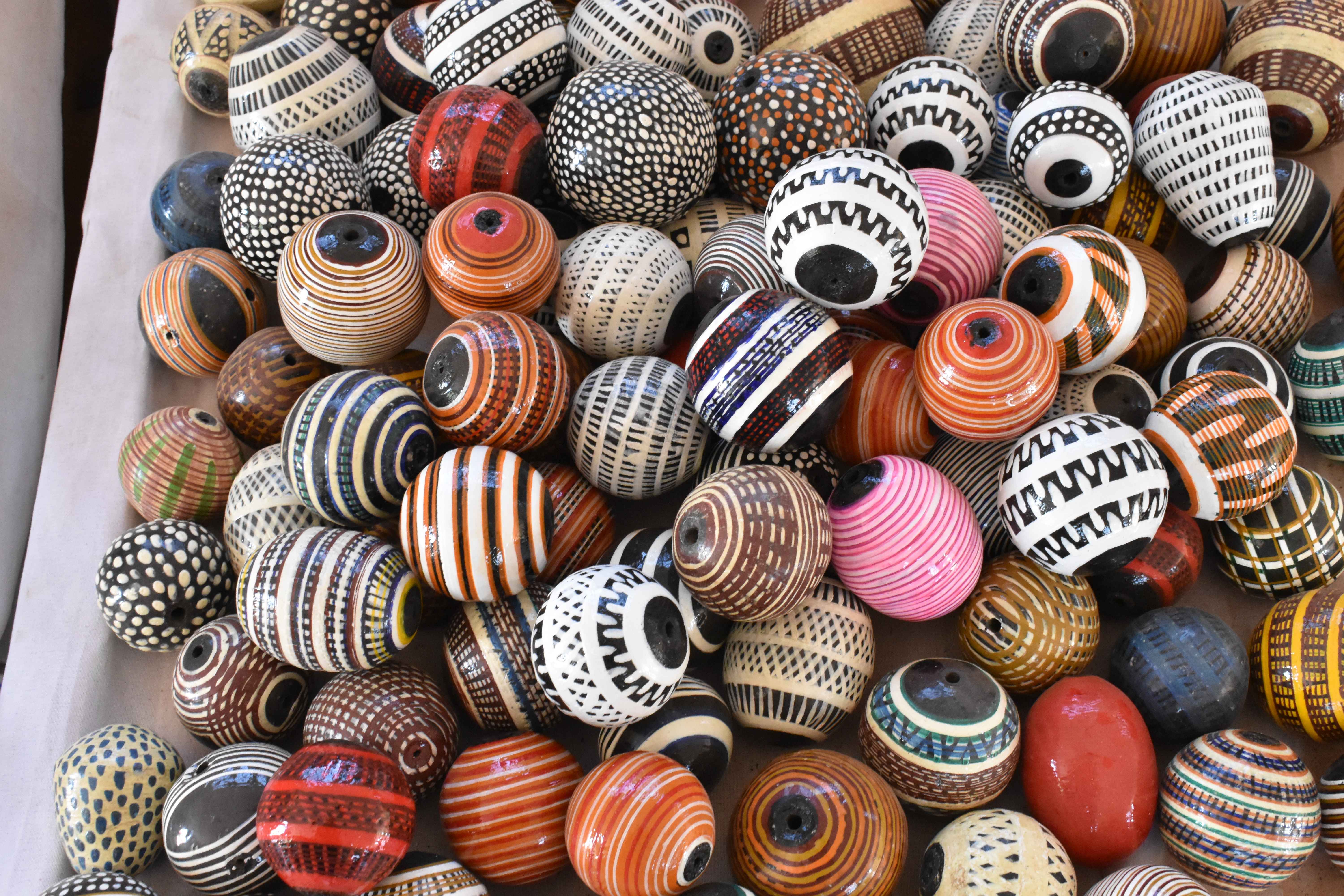
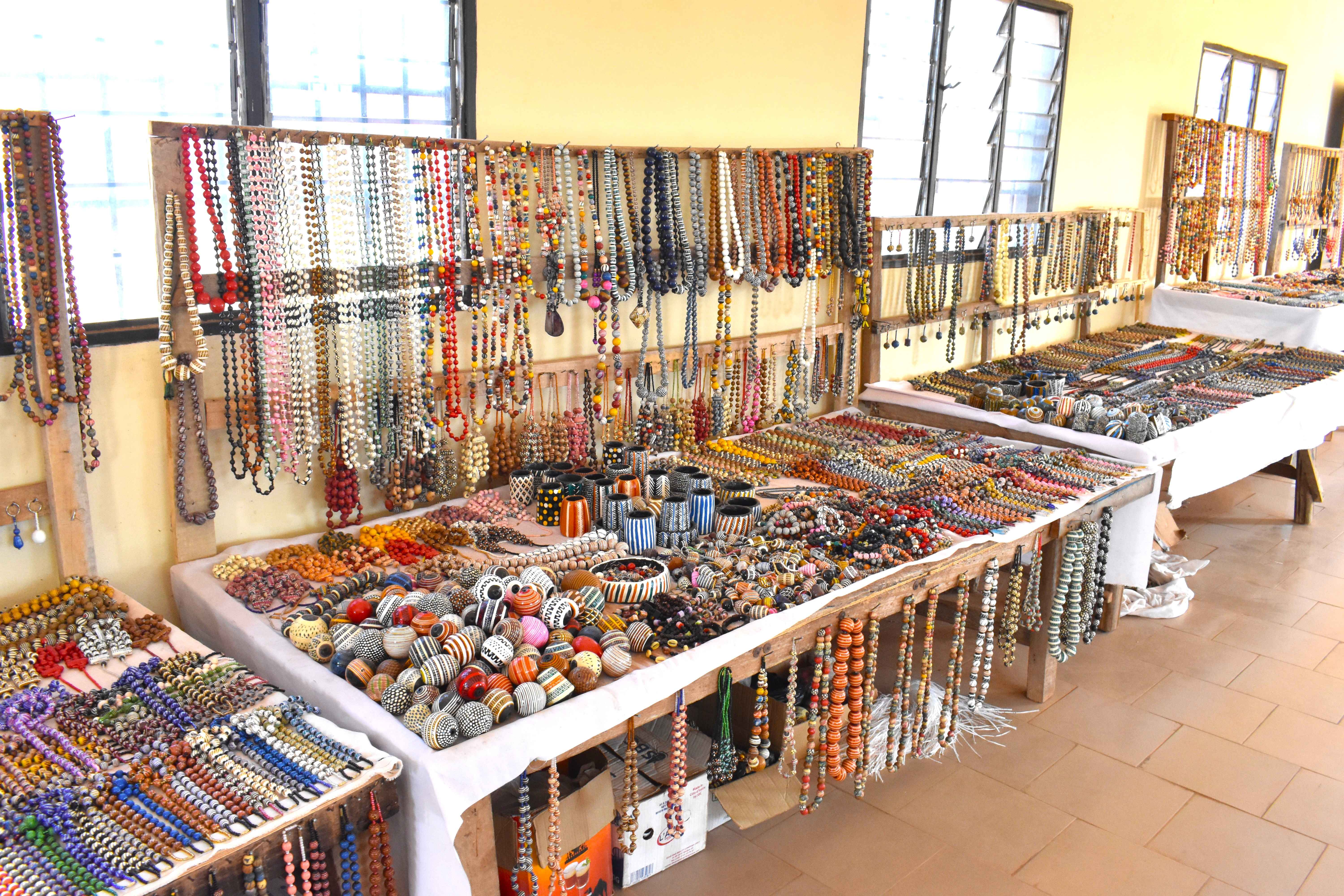
Kapélé, a village just a few kilometres from Korhogo in northern Côte d’Ivoire, is renowned for its traditional clay beads which are made into necklaces, bracelets, earrings and other decorative objects. Here we visited the workshop of the Sénoufo artisans known as the Perliers de Kapélé.
Their site was reconstructed and officially inaugurated in 2025 by the Minister of Tourism and Leisure, and designed to promote traditional craftsmanship, preserve cultural heritage and create opportunities for training, employment and tourism for younger generations.
We had previously seen beads being made in Ghana from recycled and ground glass, but Kapélé’s beads are very different. Here, they are made from clay, sourced locally from a river bed. Once collected, it is dried, pounded and sieved before being rehydrated and worked into a malleable material.
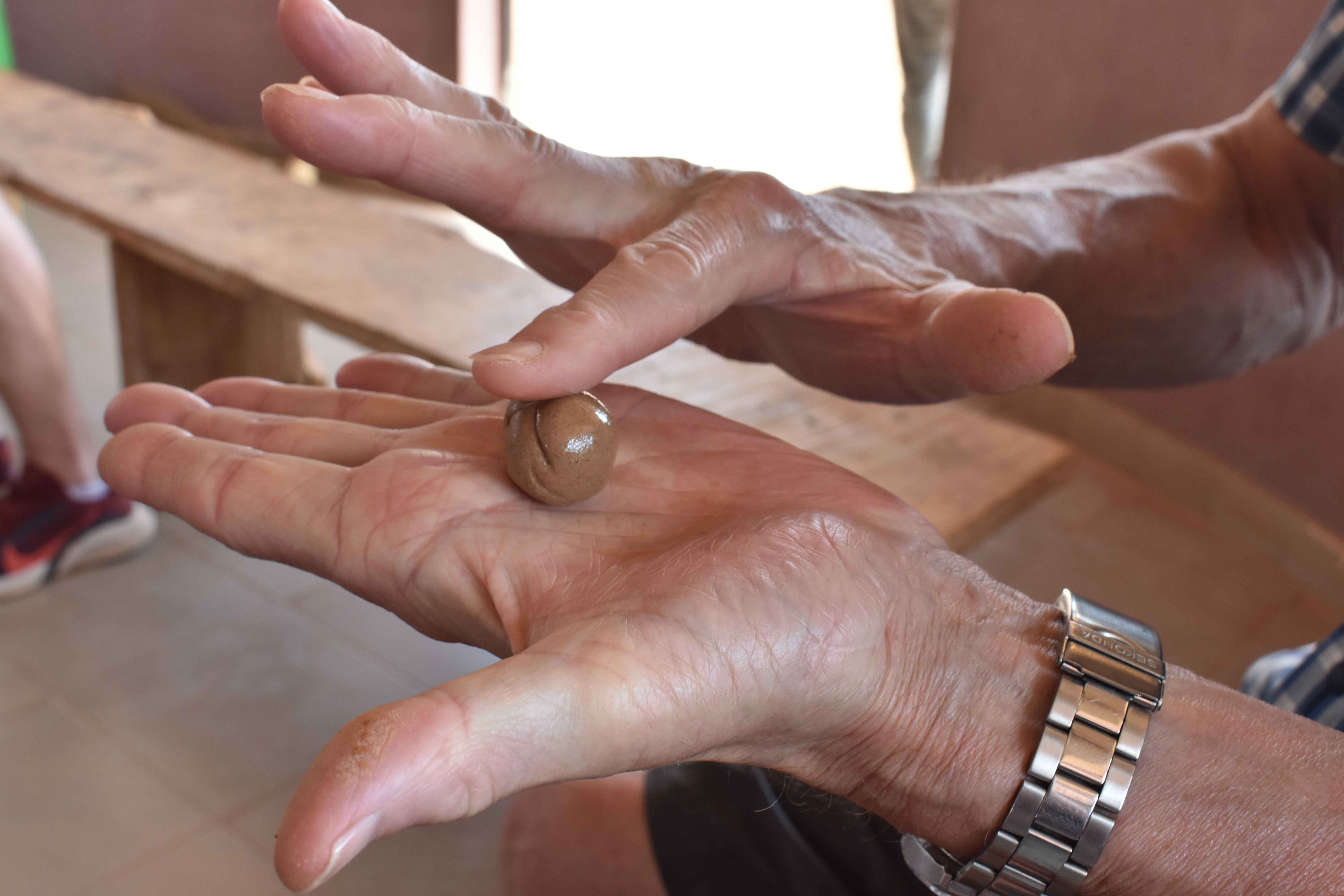
We were given the chance to have a go ourselves. A little shea butter was rubbed into our palms before we worked a small ball of clay, smoothing it into shape so that it resembled a Malteser. Once the basic form had been made, a bamboo skewer was pushed through the centre to create the hole through which the finished bead would eventually be threaded.
The beads are then left to dry for around 24 hours before being fired in a remarkably simple kiln. Rather than a conventional oven, a shallow pit is dug in the ground, the beads are placed inside and then covered with branches for a slow, smothered firing. This traditional method gives the beads their characteristic dark, almost black, base.
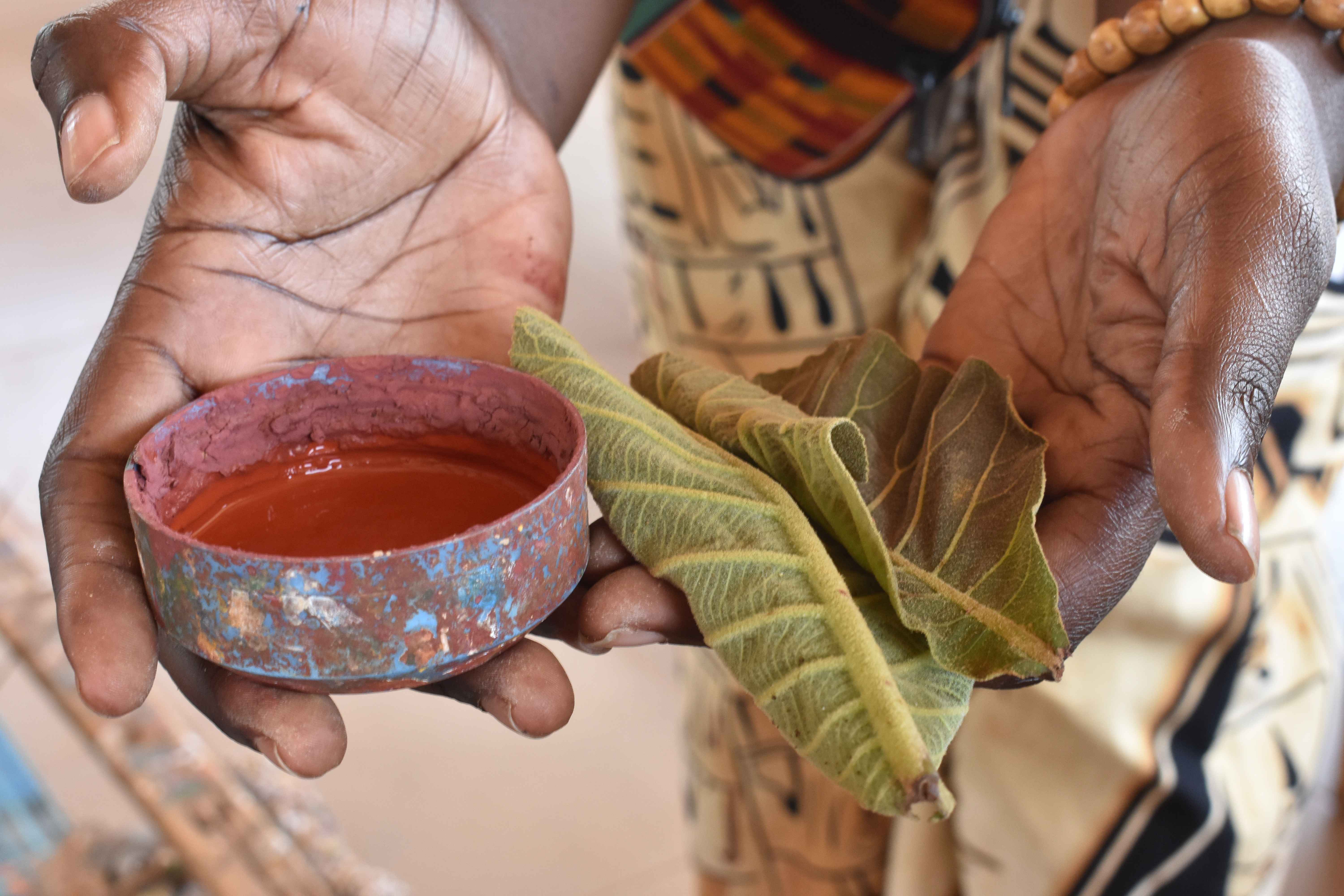
Then comes the artistic part: decoration. The traditional colours are derived largely from natural materials found in the surrounding environment. Kaolin provides white, crushed kinkéliba leaves produce green, and young teak leaves give a reddish colour, while earth can provide yellow or ochre tones. Blue, however, is not traditionally obtained from a local natural pigment.
After a short demonstration, we were ready to paint a bead which, in the words of a well-known television programme, had clearly had its crucial part “being prepared earlier”.
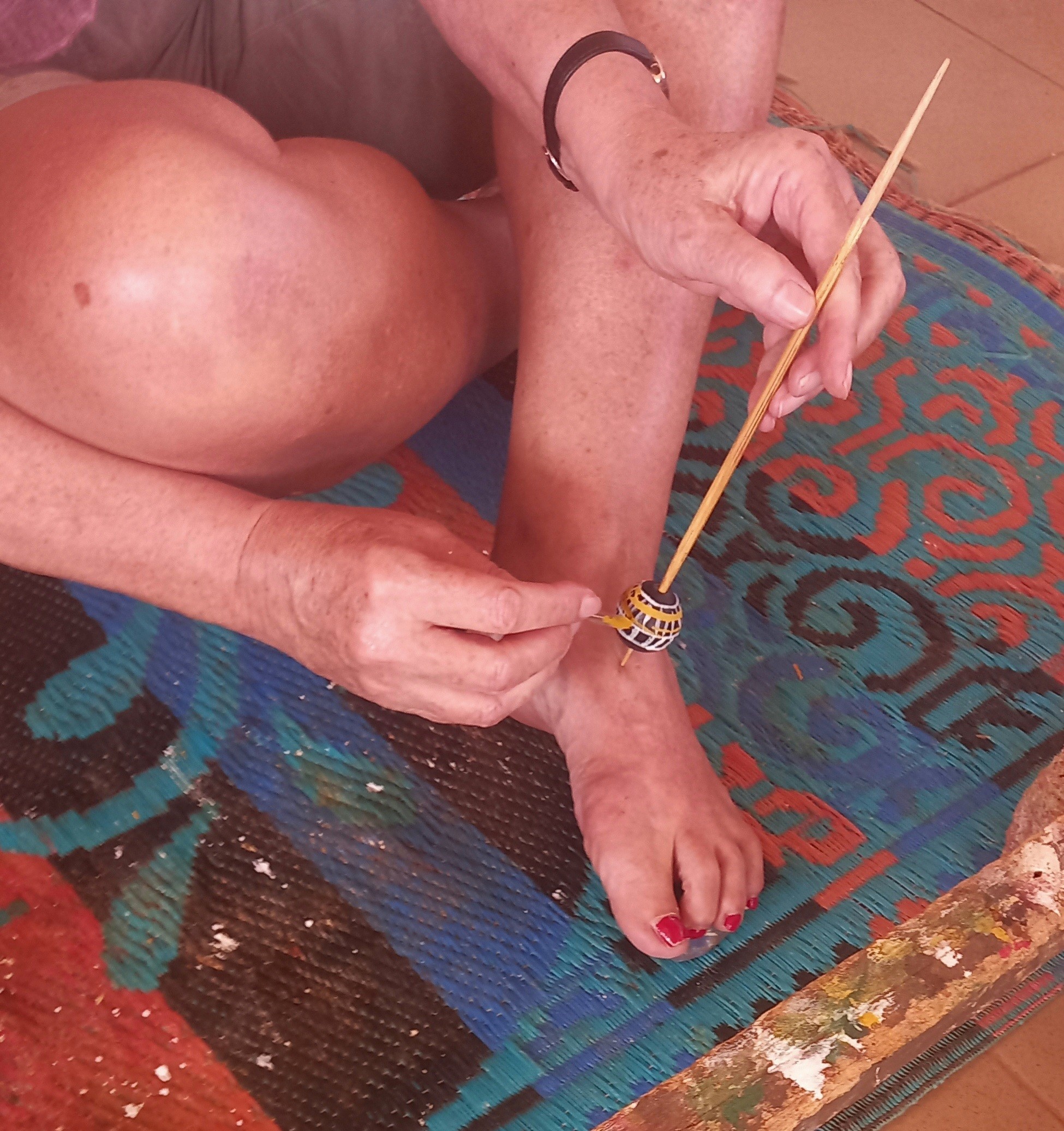
Our instructor showed us how to rest the stick holding the bead against our foot and rotate it while applying the paint. Instead of a conventional paintbrush, tiny feathers, traditionally from a guinea fowl or chicken, are used to create the fine lines and patterns. The technique looked wonderfully simply when performed by an expert. Our attempts were rather less convincing.
Trying to keep the bead turning steadily while making the paint meet itself in a continuous line was harder than it looked. And then there was the small matter of sitting on the floor to do it. Still, it was great fun, and the inevitable wobbles simply added to the charm of our handiwork, or I like to think it did.
Our rather wonkily painted bead was eventually varnished and left to dry. From start to finish, the traditional process of producing a necklace can take around two days, allowing time for the clay to dry, the beads to be fired and decorated, and the finished pieces to be varnished and assembled.
While our bead was drying, we were invited into an adjoining building where the artisans had individual stalls displaying their work. There was plenty of choice, although many offered broadly similar bracelets and necklaces, so the challenge was deciding which combinations of colours and patterns appealed most.
After a little light haggling, I eventually chose two black-and-cream bracelets, matching earrings and a Christmas decoration. The total cost was 4,000 CFA francs, or just over £5, making them not only attractive souvenirs but a remarkably inexpensive way of supporting the local artisans.
We left Kapélé carrying two very different kinds of souvenirs: our slightly wonky, hand-painted bead and some much more professionally decorated jewellery. It was an enjoyable and fascinating morning, and a chance to see a traditional craft that is now being actively preserved and promoted as part of the region’s cultural heritage.