
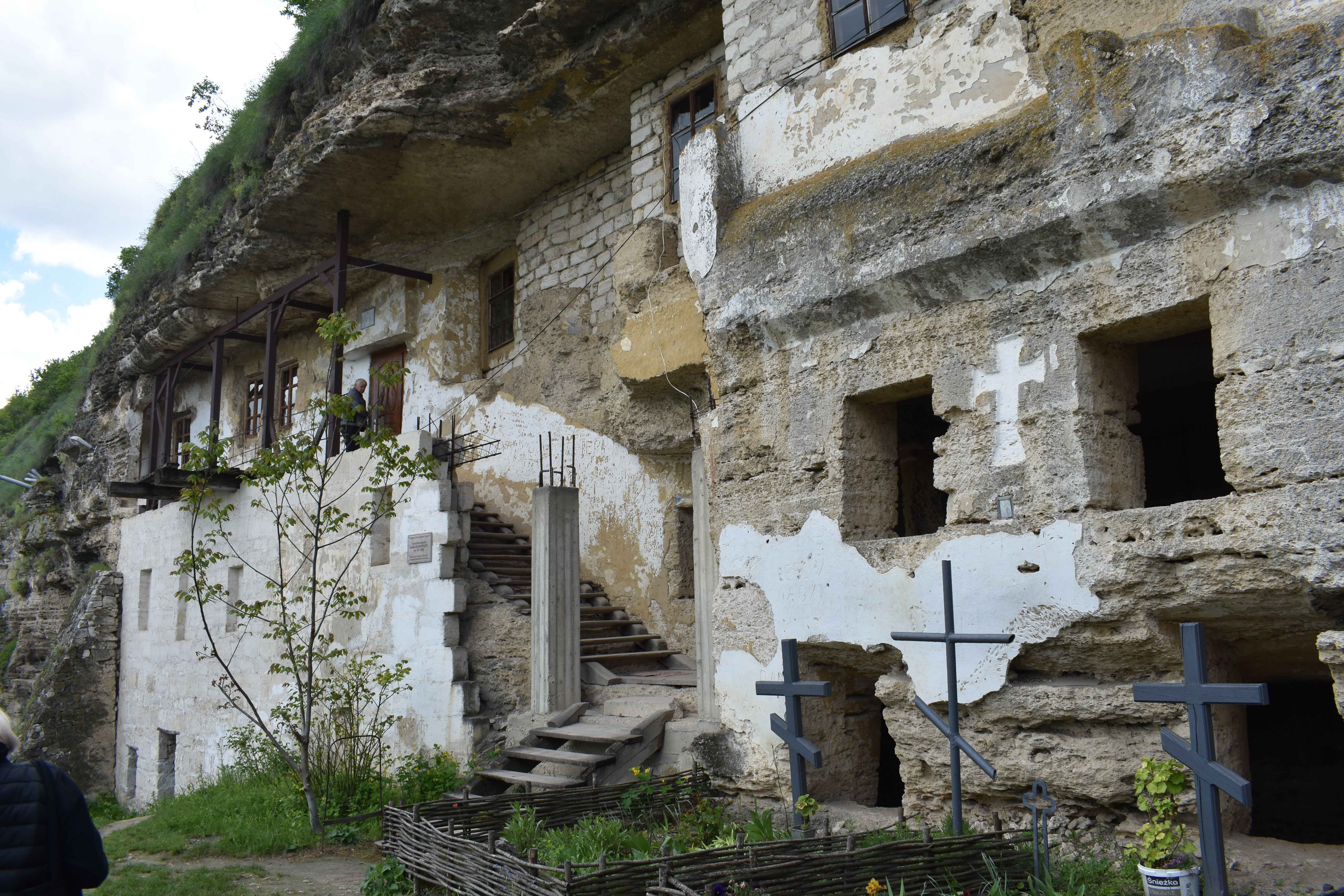
During our 17-night tour of Moldova we visited a variety of Orthodox monastic communities with both monks and nuns. They ranged from ancient cave hermitages carved into limestone cliffs, to large modern monasteries with farms, schools and extensive pilgrim facilities. Although each had its own distinctive character, there were two recurring themes. The first was the survival of monastic life through the Soviet era when religion was banned. The second being the tradition of separate churches for different seasons: large summer churches were difficult and expensive to heat during harsh weather, so smaller, warmer winter churches were maintained.
CAVE MONASTERY OF BUTUCENI
The Cave Monastery of Butuceni involved a short hike along a recently completed and beautifully constructed stone path funded by the European Union, passing two cemeteries with distinctive blue crosses.
Cave monasteries represent one of the oldest forms of monastic life in Moldova and here monks had carved a chapel and cells directly into the limestone cliffs overlooking the Răut Valley. Unlike the larger monasteries we later visited, Butuceni retained an intimate and almost hermit-like atmosphere.
Our guide explained that the monastery now has a 78-year-old monk: a former engineer, who embraced monastic life after the death of his wife three years ago. Despite the remoteness, cold solitude, he is said to only leave every three months to collect his pension. This is passed on to his family as he is supported by the monks of the nearby Church of the Nativity of the Virgin Mary.
Outside, a narrow, rather precarious ledge offered dramatic views across the valley and here pilgrims had tucked slips of paper containing prayers and wishes into cracks in the rock. Of all the monasteries we visited, Butuceni felt the most remote and contemplative, preserving something of the simplicity of early monastic life.
ȚIPOVA ROCK-HEWN MONASTERY
If Butuceni felt intimate, Țipova was monumental: it is regarded as the largest Orthodox cave monastery in Eastern Europe.
Monastic life began here in the tenth century and expanded during the eighteenth century. After closure and destruction during the Soviet period, religious services resumed in 1994 following Moldovan independence.
The monastery is associated with several legends. One claims that it hosted the wedding of Ștefan cel Mare and Maria Voichița, while another suggests that the mythical poet Orpheus spent his final years in the surrounding hills.
We passed the modern monastery on the cliffs above the Nistru River, and descended a path with a series of steep, uneven steps, to reach the original cave complex. Here exhibits explained the local history, regional survival, and religious heritage.
Whilst the dramatic setting and sense of history made it one of the most impressive sites, it was also the most physically challenging to visit.
RUDI MONASTERY
Hidden deep within a remote valley, Rudi Monastery provided a striking contrast to the rugged cave monasteries. The approach involved negotiating a steep muddy track, this time by car, before reaching a peaceful community of around thirty nuns.
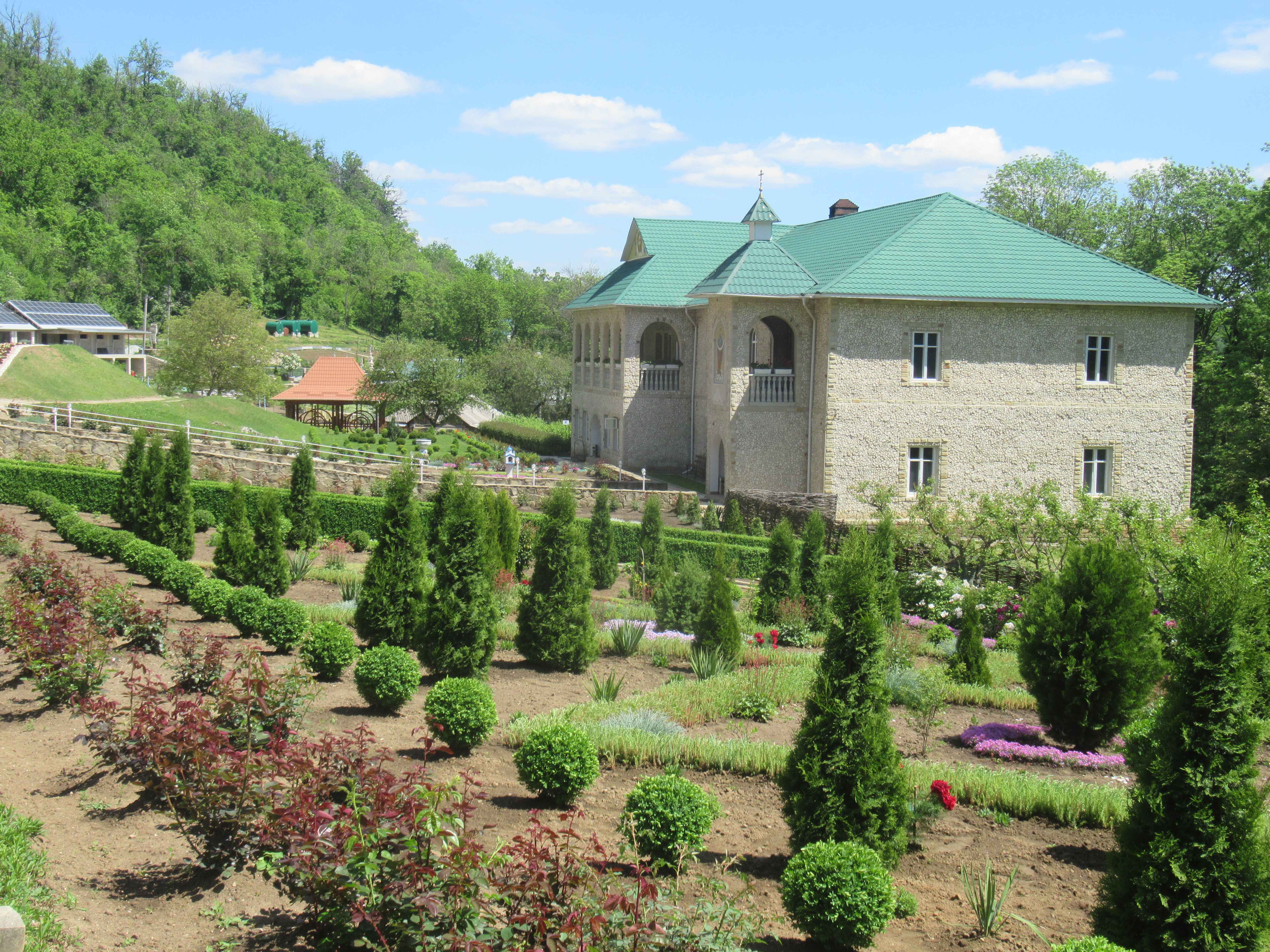
Whilst women must cover their heads in all monasteries, here a knee length skirt over my trousers was required and provided. The immaculately maintained gardens, with their colourful flower beds, immediately created a welcoming and peaceful atmosphere.
The monastery includes both a restored historic church and a modern church, together with accommodation for pilgrims, a large refectory and living quarters for the nuns. Compared with the dramatic landscapes of Butuceni and Țipova, Rudi’s appeal lay in its tranquillity and sense of order and it felt less like a historic monument and more like a living religious community.
HÎNCU MONASTERY
Hîncu is one of Moldova’s most important monasteries and is closely associated with pilgrimage. According to tradition, it was founded in 1678 after a Moldovan nobleman vowed to establish a monastery if he and his daughter escaped a Tatar invasion. His daughter later became the monastery’s first nun.
During the Soviet era, when the monastery was closed, it was converted into a tuberculosis sanatorium, and one of its churches was said to be used as a dance hall before religious life returned in 1990.
Today the convent is home to around one hundred nuns and novices. And as well as a cemetery, accommodation block, and several churches there was also a large unfinished cathedral reflecting its continuing growth.
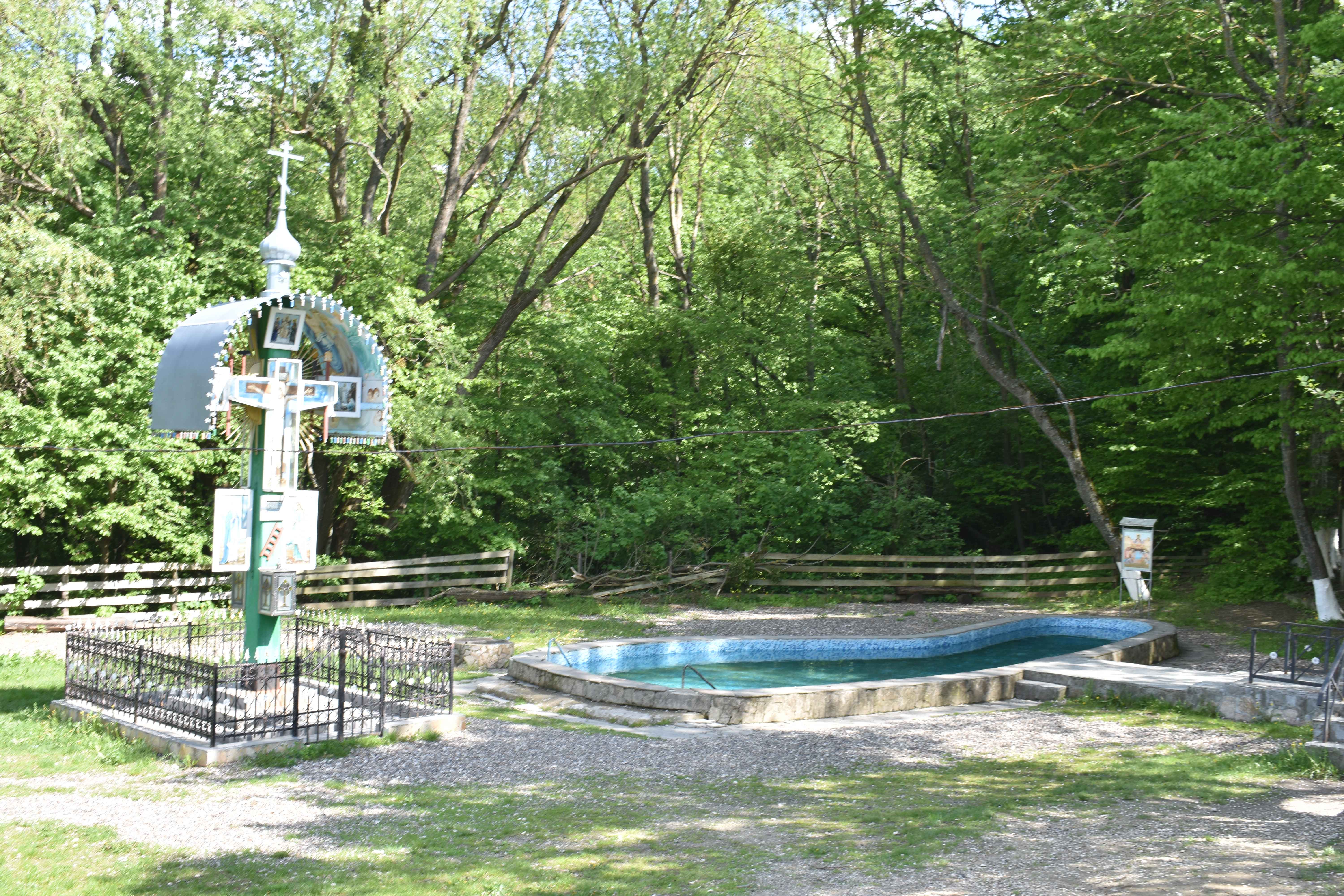
One of the most interesting aspects of Hîncu was the insight it provided into Orthodox pilgrimage traditions. A path led to a bathing pool, in the shape of a foot, fed by natural springs, where female pilgrims immerse themselves before undertaking a ritual walk around the pool. Nearby were holy-water fountains and symbolic Orthodox crosses featuring a skull and ladder.
Although we saw few nuns during our visit, Hîncu felt like a major religious centre, combining pilgrimage, worship and daily monastic life on a large scale.
ZĂBRICENI MONASTERY
The complex of a cathedral and two chapels was unusual for its Greek-inspired architectural style. This was the only monastery where we required a guide, but it meant we gained the greatest insight into contemporary monastic life. Although we expected a rather dull, quiet and formal visit, Father Paise, who arrived at the monastery twenty years ago from college, was an engaging and charming guide who spoke so enthusiastically and quickly, our guide struggled to translate.
Unlike the traditional enclosed summer churches found elsewhere, Zăbriceni’s summer church consisted largely of open-air covered structures. The new Byzantine church was still being decorated with murals, a project expected to take several years, and to demonstrate the amazing acoustics Father Paisie sang for us.
The monastery combines spiritual life with extensive agricultural activity. The monks cultivate fruit, vegetables, herbs and medicinal plants, and maintain apiaries. Seeing the refectory, capable of seating three hundred pilgrims, and learning about the monks’ daily routine of prayer and work, provided a fascinating glimpse into modern Orthodox monasticism.
More than any other monastery, Zăbriceni demonstrated how traditional monastic values function alongside a modern, economically active community and before we left, we bought herbal teas from the shop.
CĂPRIANA MONASTERY
Founded in 1429, Căpriana is among the oldest monasteries in Moldova and following decades of closure and neglect during the Soviet era, it became one of the first monasteries to reopen in 1989 emerging as a symbol of national revival.
The monastery is closely associated with Saint Gavriil Bănulescu-Bodoni, and we saw the original, now empty burial vault, as his relics were transferred to the summer church following his canonisation. Particularly notable was an icon linked to Mount Athos, reflecting the monastery’s wider connections within the Orthodox world.
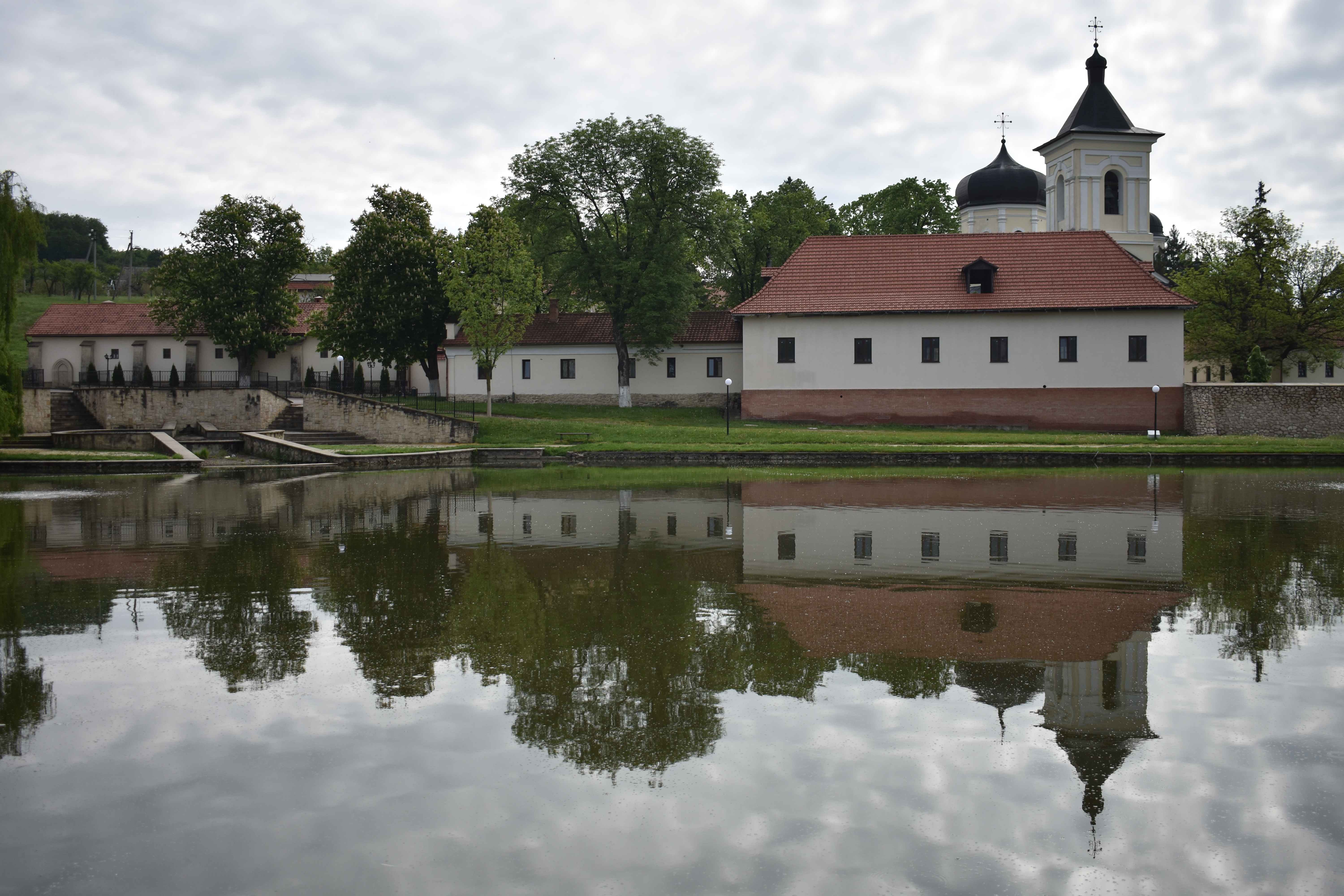
The colourful frescoes and peaceful lakeside setting made it particularly attractive and as it is home to around twenty monks, the monastery also maintains fishing ponds, reflecting the traditional monastic diet that excludes meat.
Of all the monasteries we visited, Căpriana perhaps best combines historical significance, spiritual importance and architectural beauty.
MARTHA AND MARIA MONASTIC COMPLEX
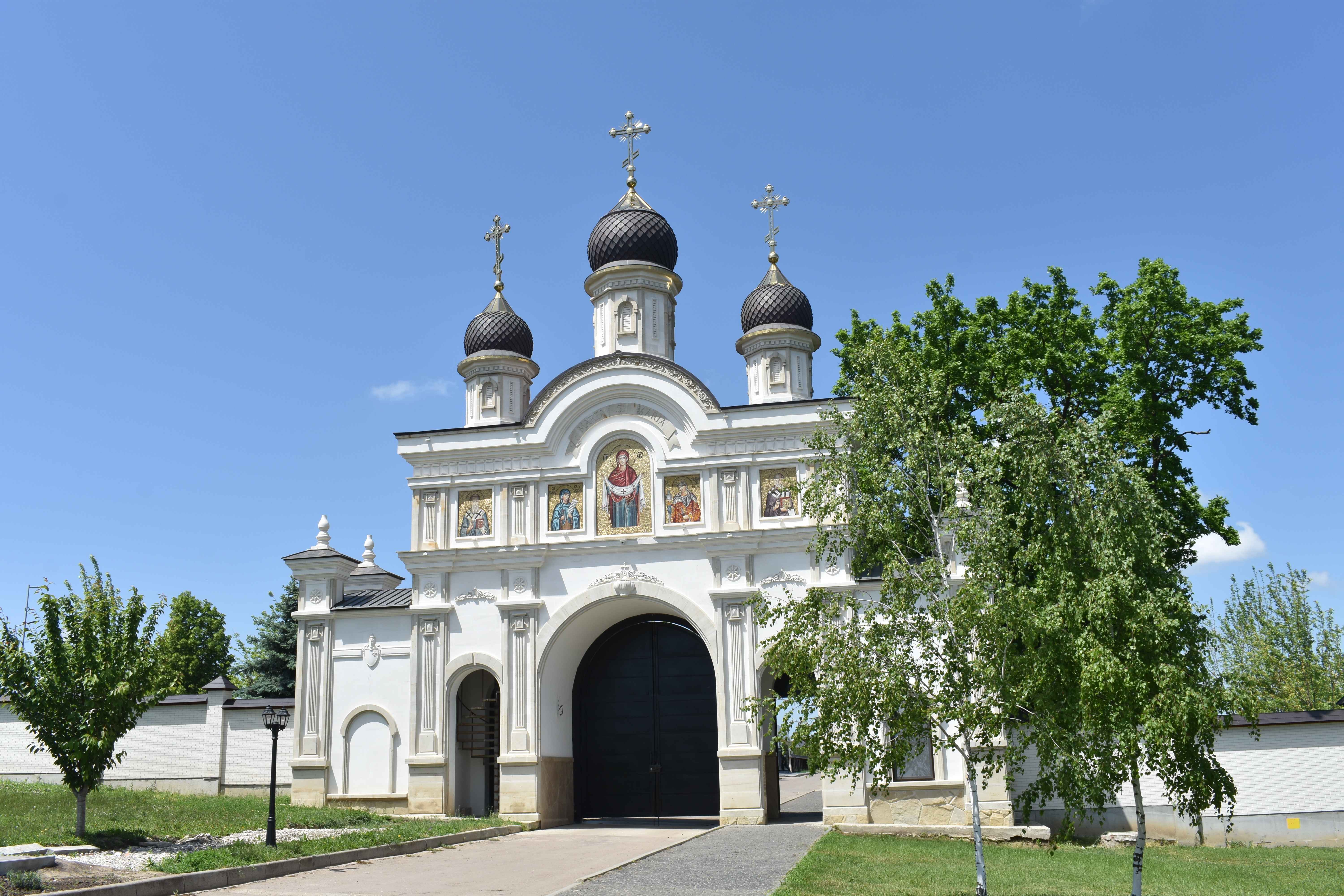
Founded in 1997, the complex is one of the newest monasteries. The centrepiece was a striking two-storey cathedral with black onion domes, incorporating both the summer and winter church in one building. Unfortunately, it was closed for cleaning, as was a wooden church tucked away among mature trees and landscaped gardens. Built in the traditional way using joinery and wooden pegs rather than nails, it was dedicated to Ștefan cel Mare, Moldova’s most celebrated medieval ruler.
The landscaped grounds included a holy spring dedicated to the Virgin Mary and an impressive statue of Ștefan.
The monastery is dedicated to Martha and Mary of Bethany, whose biblical story symbolises the balance between practical service and spiritual devotion. That balance was reflected throughout the complex as the monastery, which is home to around sixty nuns, combines religious, educational and agricultural activities on a substantial scale. It manages seventy hectares of land, maintains a dairy herd of more than two hundred cattle and operates two retail outlets selling both religious crosses, candles and icons, and agricultural produce like meat, cheese and milk. It also has a theological seminary where girls combine religious education with traditional church arts such as icon painting.
While lacking the centuries of history associated with Căpriana or Țipova, Martha and Mary demonstrated that Moldovan monasticism remains a vibrant and evolving tradition.
ASSUMPTION OF THE VIRGIN MARY CHURCH
Although not a monastery, the Assumption of the Virgin Mary Church in Căușeni complemented our visits to Moldova’s monastic sites by providing an insight into the country’s religious heritage.
At first glance the building appears surprisingly modest, resembling a simple stone house rather than an Orthodox church. Historians are said to be still debating its origins, with construction dates ranging from the fifteenth to the seventeenth century. Its unusual sunken position reflects a period of Ottoman domination, when Christians were forbidden from building churches higher than the lowest or main Islamic buildings in the town. As a result, we descended steps to enter.
The building has been extensively restored through a collaboration involving US AID and Moldovan heritage authorities. Unlike most Orthodox churches, the iconostasis was carved from stone rather than wood and as the place now functions as a museum rather than an active place of worship, we were able to pass behind it, to the area normally reserved for the priests.
The church is particularly renowned for its remarkable frescoes, dominated by shades of blue and red. Conservation work has revealed evidence of multiple layers of painting, illustrating how the interior evolved over the centuries. To protect these fragile artworks, visitor numbers are restricted to twenty-five at a time to maintain stable humidity levels.
During the Soviet era it was used for drying and smoking plums and smoke damage was visible on the upper walls, while flood marks could be seen lower down. Ingenious construction techniques, including timber beams embedded within the stone walls, helped the structure withstand earthquakes. Small openings in the walls once held ceramic pots, a system designed to improve the acoustics.
Although lacking the monastic communities and active religious life found elsewhere on our tour, it was yet another example of the resilience of Moldova’s religious heritage.

