
Remember in history lessons at school, there was a big gap between the Romans leaving Britain and the Norman Conquest. No-one knew much about it and it was referred to as the ‘Dark Ages’.
We learned about Alfred burning the cakes and the Vikings as well as King Canute trying to stop the tide coming in, but that was all.
Over the last 60-70 years our knowledge has grown and we have come to realise that there was a lot happening during that period and Anglo Saxon culture was a lot more sophisticated than we realised. There are the remains of Anglo Saxon Churches across the country and the Lindisfarne Gospels are a masterpiece of Anglo-Saxon and Celtic art.
Then there are the carved crosses, found mainly in the north as well as the Isle of Man.
Some people may have heard of the Sandback Crosses, Ruthwell Cross, Easby Cross or the Bewcastle Cross. Chances are they won’t have heard of the Crowle Stone…. It doesn’t feature in much of the literature and very little is made of it in the publicity for North Lincolnshire.
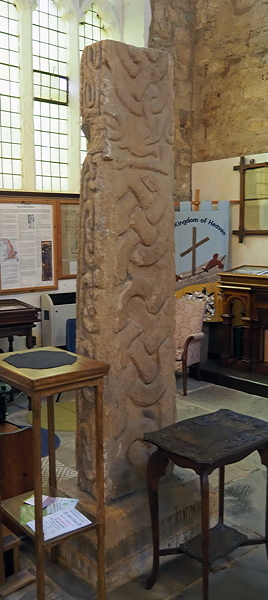
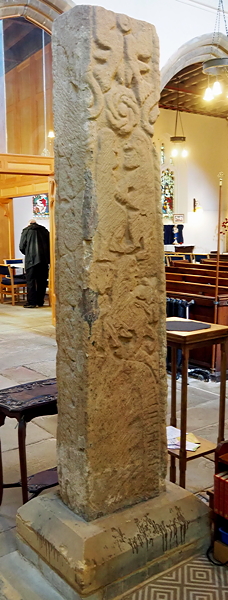
The remains of the carved cross shaft is to be found in St Oswald’s Church in Crowle, now a small and rather forgotten part of North Lincolnshire. However at the time of the Domesday Book, it was one of the major settlements in the area.
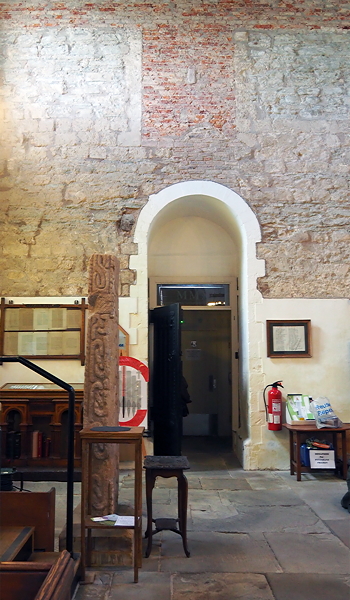
Little is known about the history of the cross, although it is thought to date from about 950. It was incorporated as a lintel in the church door when the Normans rebuilt the Saxon church, which explains why it survived. It stayed there until 1919 when it was removed and is now displayed in the back of the church.
Three of the sides have interlooping Celtic style carving. The fourth side has carved Norse figures. At the top are two bird like creatures. Below are two bearded male figures with a bearded horseman below. At the base is the remains of the runic inscription, which suggests this was originally a memorial stone.
It is a remarkable survival in this part of the country. For anyone with an interest in the Anglo Saxons, this ought to be included on their ‘to do’ list along with St Peter’s Church in near by Barton on Humber which has a Saxon tower and baptistry.
https://www.english-heritage.org.uk/visit/places/st-peters-church-barton-upon-humber/
St Oswald’s Church has no formal opening times apart from services and the first Wednesday of the month at 2pm when it is open for ‘Tea at Two.’ They can be contacted by their website to arrange for a visit.
https://www.achurchnearyou.com/church/14748/get-in-touch/