Silver Travellers may have visited Bucharest on an excursion from a Danube cruise. However, it is worthy of a longer visit, and we bookended our tour of Romania with stays of four and three nights, at two different hotels.
On arrival, we stayed in the Hotel Capitol, and due to its location, concentrated sightseeing on the southern part of the city. A guided half-day city tour provided an historical overview and orientation, and we then decided which places we wanted to visit in depth. Whilst there was a metro system, we found the city easily walkable.
Bucharest was known as ‘Little Paris’ in the early 20th century, due to its elegant architecture and cultural scene inspired by France. But with the advent of communism, the architecture changed. We found the main street running north to south, Calea Victoriei, flanked by grand 19th-century buildings, neoclassical monuments, and in stark contrast, Soviet-era structures. Walking the length of the street, around 30-minutes, took in all these styles.
Piaţa Revoluţiei
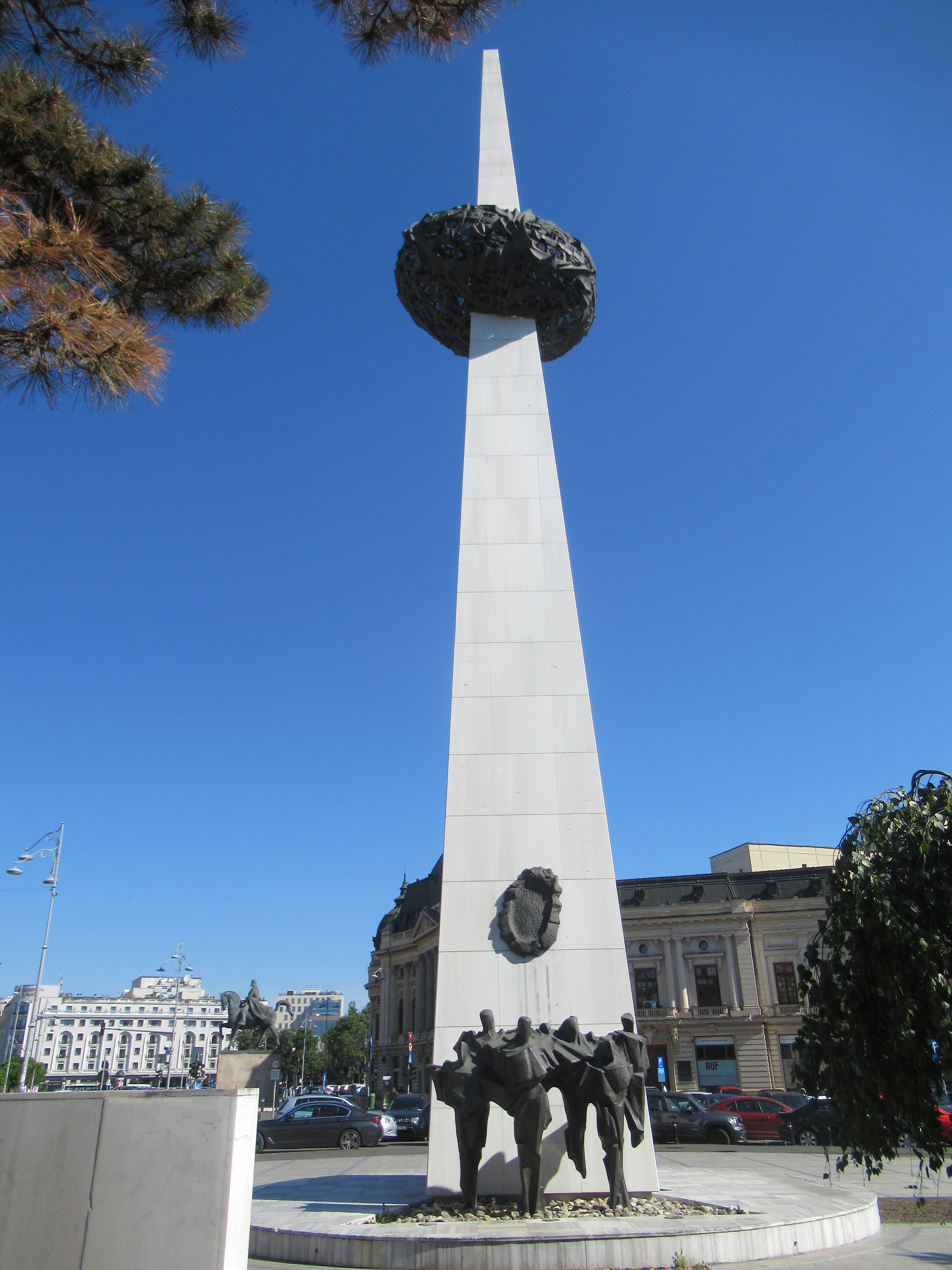
The backdrop to Piaţa Revoluţiei is a large building where some of the most iconic footage of the Romanian revolution of 1989 was filmed. The dictator Nicolie Ceauşescu made his final speech from the balcony, and it was from there he escaped by helicopter, before being caught, tried and executed along with his wife, Elena, on Christmas day 1989. In the square in front is the controversial ‘Rebirth Memorial’ erected in 2005 as a memorial to the revolution. The thin needle-shaped obelisk of white marble piercing a roundish bronze object near the top, is often referred to as the ‘olive on a toothpick’. At the foot were a group of bronze figures, and two curved walls inscribed with the names of victims. Behind was another statue, a politician Iuliu Maniu (prime minister between 1928 and 1933), and what looked like a bronze sculpture of a dead tree.
The Old Town
The Old Town is more commonly known as Lipscani because it was full of shops run by merchants who sold Lipscan goods (meaning from Leipzig). Over time, the name stuck and not only was a street named Strada Lipscani, but also the broader Old Town district that grew around it.
The tiny Stavropoleos Monastery was founded in 1724 by a Greek monk named Ioanichie Stratonikeas, who came from the city of Stavropolis in Greece, hence the name. It has a few resident nuns remaining and we were able to see the restored interior frescoes, with a few small black rectangular patches being left so we could see how it had originally looked.
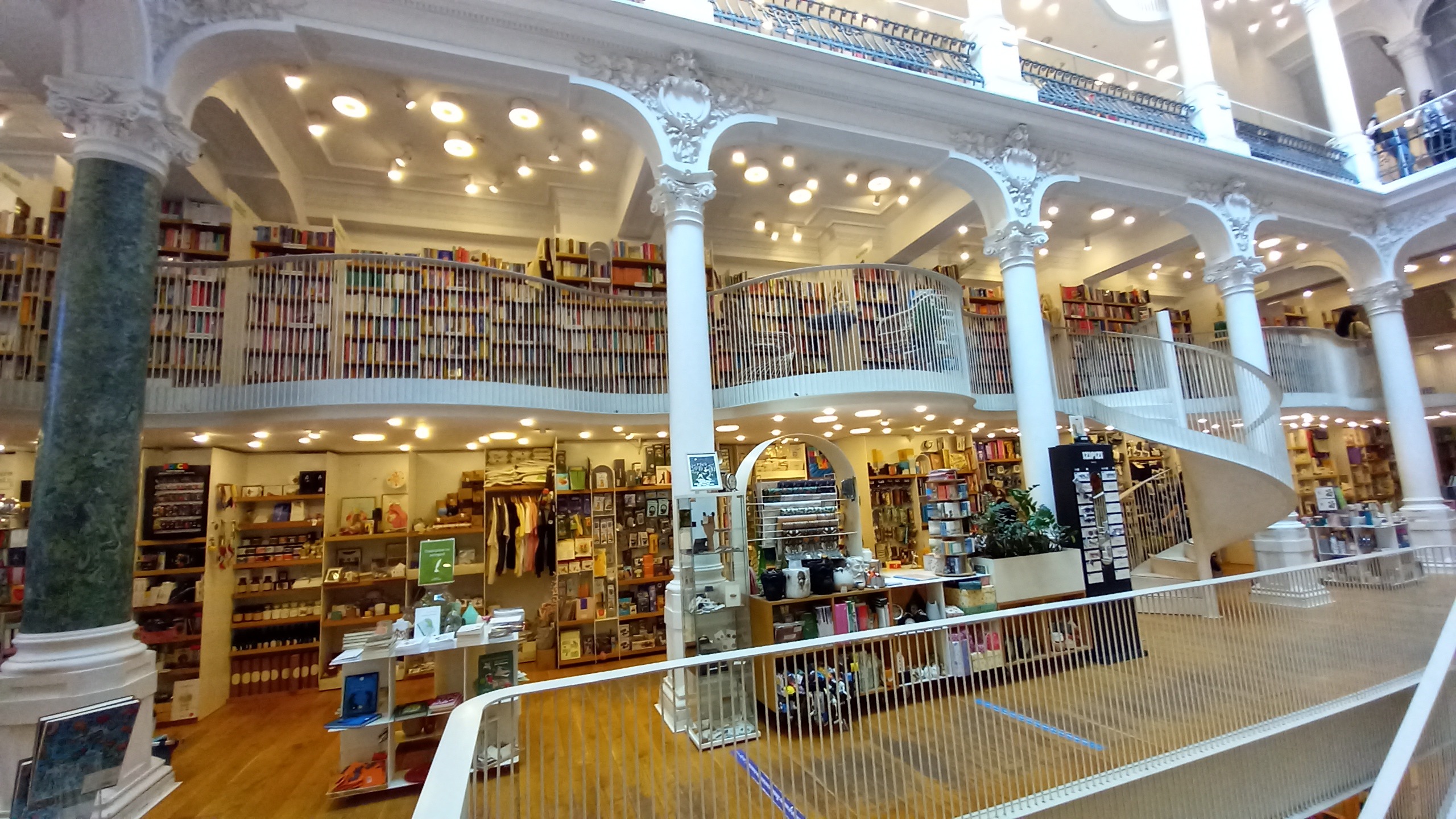
We peeped into Cârturesti Caruşel a fabulous book shop with layered white balconies, ornate columns, and a spiral staircase giving it its carousel-like feel. Originally the headquarters of the Chrissoveloni Bank, it fell into disrepair by the end of the 1990s and early 2000s but was renovated over five years and it’s now said to be amongst the most photogenic bookstores.
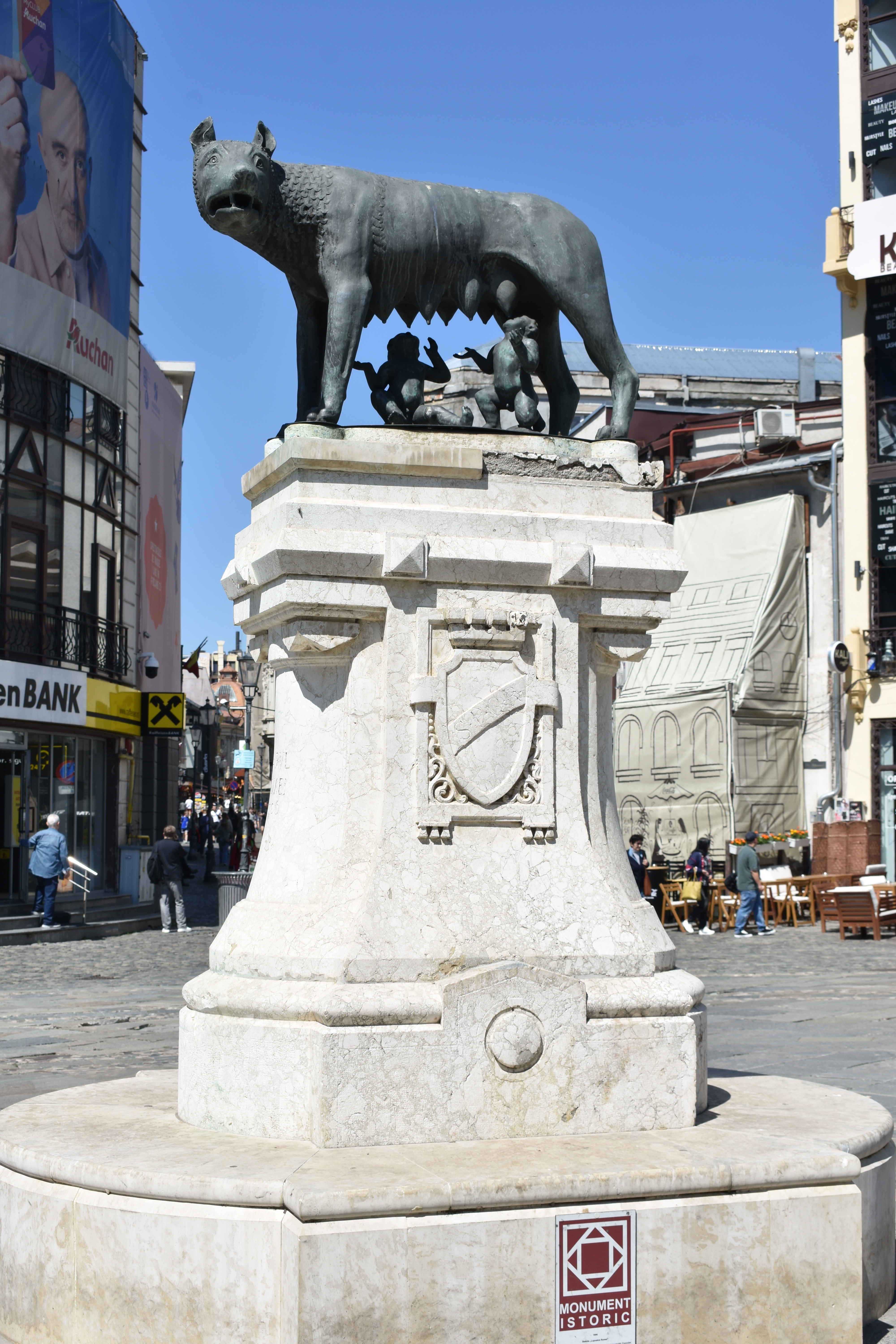
Capitoline Wolf Statue depicted the she-wolf suckling Romulus and Remus, the legendary founders of Rome. The bronze replica of the original in the Capitoline Museum in Rome, was gifted in 1906, to mark the 40th anniversary of King Carol I’s reign and 25 years since Romania became a kingdom.
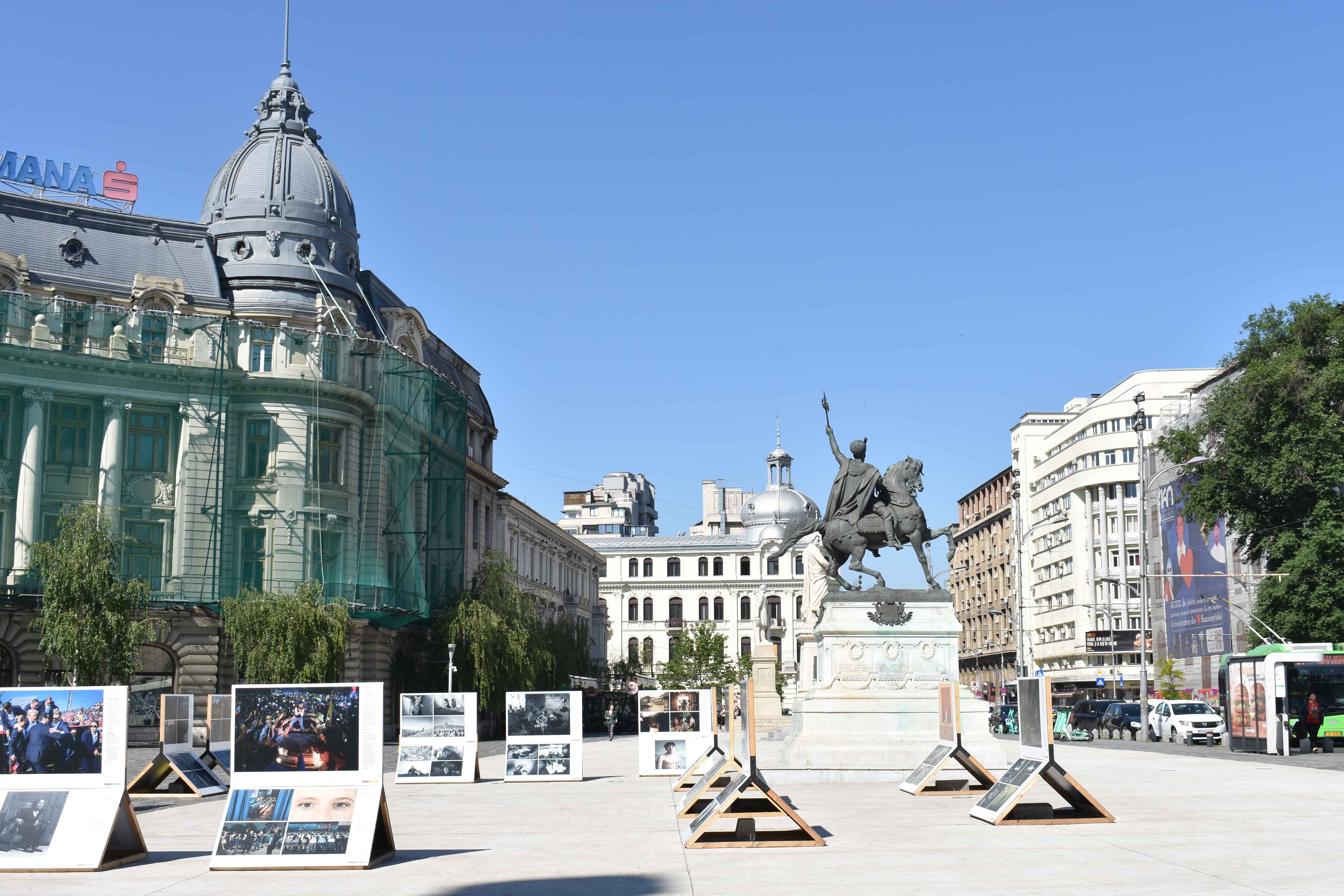
Piaţa Universitâţii had four statues erected between 1907–1939, each representing a major cultural and national figure of Romania.
Away from the Old Town, we had a long walk to the Old Jewish quarter and eventually found the Great Synagogue and more photogenic Choral Temple, but as we’d not done our homework, we found both the museums were closed in the afternoons.
For a respite we visited Cişmigiu Gardens with its large lake and Writers’ Rotunda: a circular alley with statues of major Romanian writers and poets.
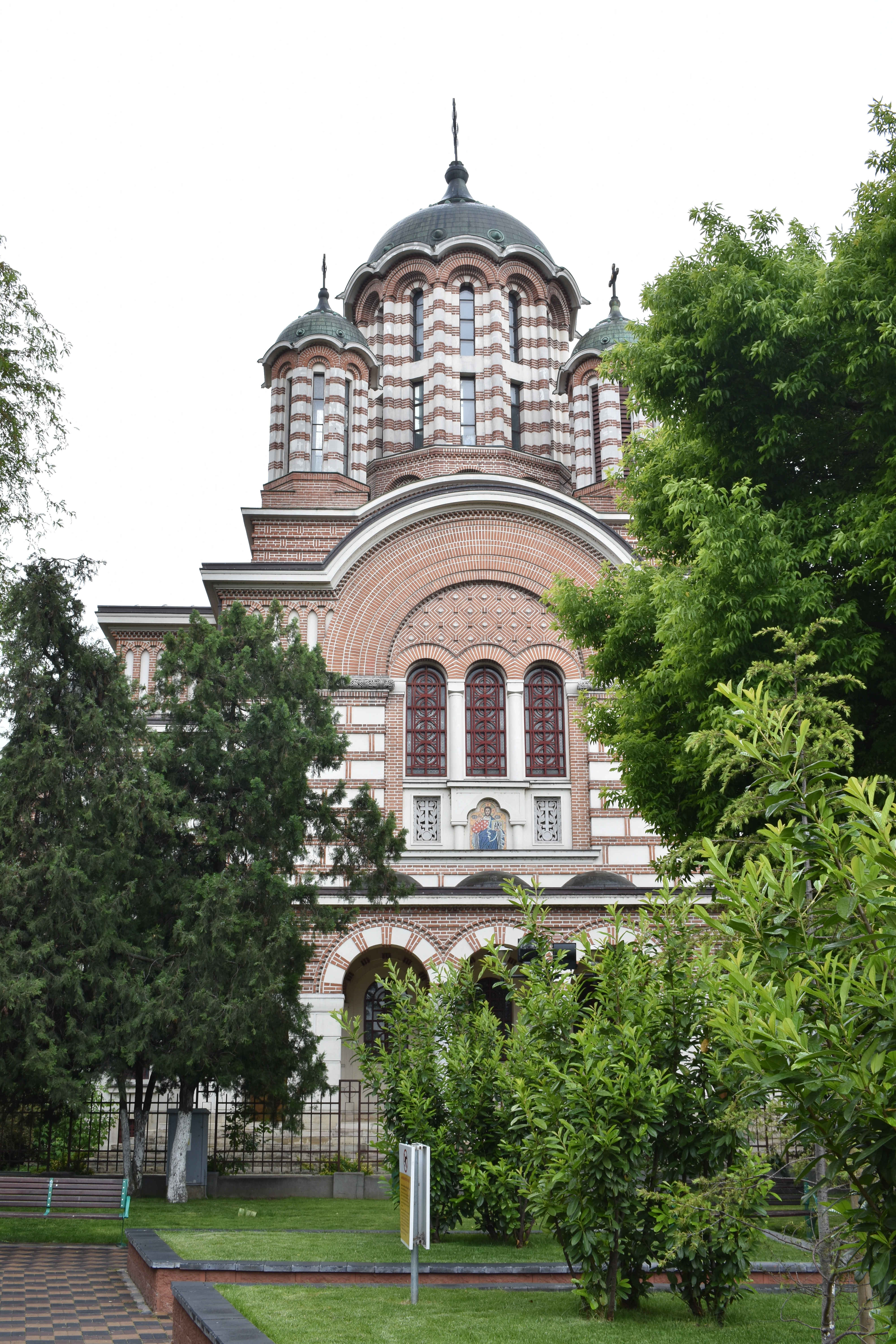
We walked, via the National Opera House, to the area called Cotroceni, Lonely Planet suggesting linden trees and fancy houses. On our self-guided walk, we took in the distinctive, red and white striped brickwork of the New St. Eleftherios Church, the brightly coloured Stairs of Happiness, and two huge stone lions flanking the entrance Villi Mimi. Whilst our aim had been to finish at Cotroceni Palace and the Bucharest Botanical Garden, it began raining heavily.
There were two disappointments which were due to presidential elections taking place during the weekend of our visit. The first was that we missed seeing the busy Calea Victoriei closed to vehicles. Under an initiative called ‘Open Streets – Bucharest, Urban Promenade’, traffic is banned during the summer on Saturday and Sunday, from 10am to 10pm. The other was that the Singing Fountains, a huge, choreographed water, light, and music show was not taking place.
See also in-depth reviews of:
Palace of Parliament – Visiting Romania’s Parliament
Casa Ceaușescu – The home of the infamous Nicolae and Elena Ceaușescu
The National Museum of the Romanian Peasant – A museum dedicated to Romanian peasants
Herăstrău Park – A peaceful park in north Bucharest
Museum of Recent Art – Antony Gormley was being restored
The Intercontinental Athénée Palace – The English Bar – A Sip, a Secret, and a Story in a Signature Bar
Arcul de Triumf or Triumphal Arch – The Romanian equivalent of the Arc de Triomphe
Romanian Athenaeum – Appalling behaviour at the Romanian Athenaeum
Museum of Communism – Exploring life under a Communist Regime
Capitol Hotel – A centrally located hotel in Bucharest
Hotel Herâstrâu – Sadly lacking the peace and tranquility we hoped for